
Finding People Through Rome Records
Begin a Rome search with the fact that has the clearest link to an official record. A full name may belong in the Floyd County deed index, a court party search, the City staff directory, or a state business and license lookup. A street address points first to the joint parcel viewer and Board of Assessors roll. A death date or family connection is better suited to vital records, historic newspapers, the library, or the Georgia Archives. Each system records a role, not a whole identity.
Write down the exact spelling, date, record role, and source for each result. Common names need context such as a middle initial, parcel identification number, case type, profession, or known associate. Rome records also cross city and county lines. A Rome postal address can sit outside city jurisdiction, so confirm the parcel and taxing authority before asking a City office for a county-held file.
- Classify the known fact as a name, address, phone number, event, court matter, or business role.
- Search the most direct official index, recording the spelling and date shown.
- Use a second Rome or Floyd County source to test whether the person and role align.
- Switch to the courthouse, custodian, library, or archives when online coverage ends.
- Request a narrow existing record when no searchable database exists.
Rome Records Offices Behind Searches
Two Floyd offices called clerk do very different work. The Clerk of Superior Court records deeds, liens, plats, trade names, and court filings. The administrative County Clerk keeps Board acts, minutes, orders, licenses, and county files. The City Clerk handles Rome commission, ordinance, permit, and administrative material. Property questions often require both the deed recorder and Board of Assessors because title history and the current appraisal roll answer different questions. The Rome public records access page covers request rules, fees, and custodians in depth.
Floyd County Deed Room
3 Government Plaza, Suite 103
Rome, GA 30161
706-291-5206
Rome Deed Index Access Paths
The Floyd land-record gateway offers free guest access to index data. Document images require a timed subscription. Its public login screen shows user ID and password fields, account creation, password help, certified dates, and a PropertyCheck link. The verified inner grantor, grantee, date, and document-type controls sit behind an account, so no search-field details should be assumed.
Prepare names and date ranges before buying image time. Save the indexed spelling, party role, instrument type, recording date, and book/page or document number. If the local portal or limited statewide collection returns nothing, the Deed Room remains the required fallback. A mailed copy request must identify the document type and book/page.
The official Floyd gateway shows where guest discovery begins:
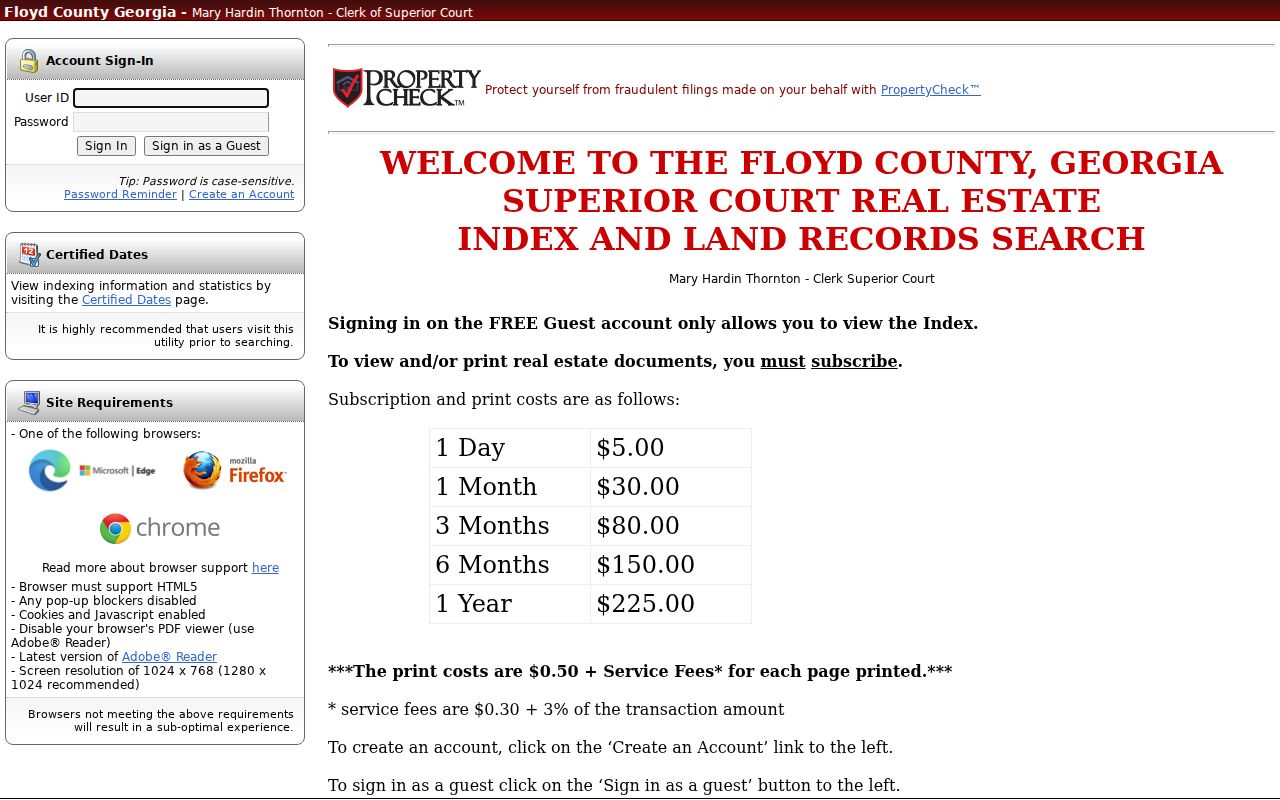
The account wall is a useful warning that a web result is only one access channel, not the full county collection.
| Access route | What it provides | Best next step |
|---|---|---|
| Free guest index | Recorded-index discovery | Capture exact record identifiers |
| Timed subscription | Document images | Prepare a batch before paying |
| Deed Room or mail | Older, missing, plain, or certified copies | Supply document type and book/page |
Rome Address Search Across Systems
An address search works best as a chain: street address to parcel, parcel identification number to assessor, owner name to deed index, then dated occupant evidence where needed. The Rome-Floyd GIS service warns that its replacement viewer does not yet carry every former layer. The assessor roll shows ownership, tract size, sale data, construction facts, and a scaled drawing, while the deed provides the title instrument.
A homestead flag can suggest owner occupancy, but it does not prove that the owner lives there now. Half-numbered and normalized local addresses create another trap. Planning records link 207½ North Avenue with a whole-number rendering, and some ranges collapse to one endpoint. Once found, the parcel identifier and legal description are safer pivots than spelling alone.
Jurisdiction check. A Rome mailing address does not establish City of Rome limits. Confirm the parcel, city boundary, and taxing authority before choosing a custodian.
Searching Rome Court Records by Name
Rome is served by Municipal Court and Floyd County Magistrate, Probate, Juvenile, and Superior courts. The Rome Judicial Circuit covers Floyd County. Georgia's court e-access directory routes Floyd Superior searches to an account-based provider, not a single free statewide case system. When the online route is incomplete, the courthouse law library has a public terminal, printer, and legal research access.
A useful request gives the party name, approximate filing year, case type, and case number if known. A docket is the court's event list, not the full file. It may show parties, filing dates, hearings, charges or claims, and disposition, while sealed, juvenile, adoption, and other restricted material stays closed. Probate offers online records from 2006 forward; older estates and full files require direct contact.
The official directory illustrates the provider-by-provider nature of Rome court access:
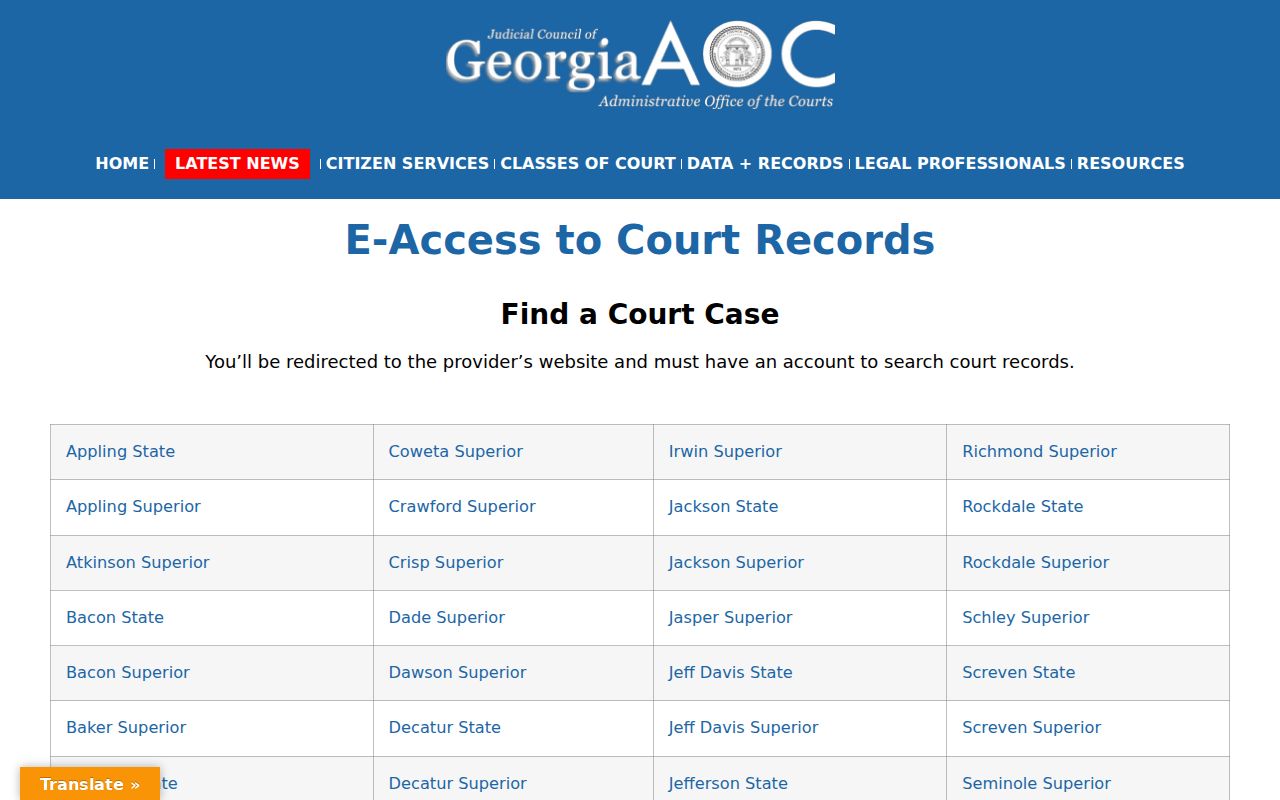
A missing online hit should prompt a terminal or clerk search before any conclusion is drawn.
| Court | Covers | Name Search | Access |
|---|---|---|---|
| Floyd Superior Court | General civil, criminal, land, and equity matters | Account-based Floyd provider | Web provider, public terminal, or clerk |
| Floyd Probate Court | Estates, guardianships, marriage, petitions | Georgia Probate Records | Online from 2006; court fallback |
| Rome Municipal Court | City ordinance and traffic matters | No central statewide ticket database | Municipal Court contact |
| Northern District of Georgia | Federal cases | PACER | Account and per-page charges |
Tracing Rome Vital Records
Georgia's Department of Public Health issues statewide birth and death records from January 1919. The Floyd County Health Department is the local registrar route. Certified birth and death copies require eligible applicants, identification, and a direct and tangible interest under O.C.G.A. §§31-10-25 and 31-10-26. Public plain-paper death copies may be issued with the Social Security number redacted. Probate Court handles Floyd marriage records outside the state office's limited marriage range.
Older records move toward archival access. Birth records transfer after 100 years, while death records, marriage applications, and divorce records transfer after 75 years. Before those periods, a family researcher may need the proper applicant, a court record, cemetery evidence, or a dated newspaper notice. Divorce decrees remain with the Clerk of Superior Court rather than DPH.
Request channels vary by record. DPH accepts eligible requests through its published online, mail, and office routes, while Floyd Probate is the better starting point for local marriage and estate questions outside state coverage. A certified copy carries the custodian's certification for official use. An index entry or plain paper copy can aid family research but is not the same product. State fees were updated in March 2026, so confirm the live DPH schedule before sending payment and identification.
Rome Business and License Search
The Georgia business search can connect a person to an entity as registered agent, officer, or designated agent. It supports Starts With, Contains, and Exact Match modes plus business name and control number. The result proves a filed business role at a point in time, not ownership of every business asset or current daily work.
The official portal makes those role-based modes visible:
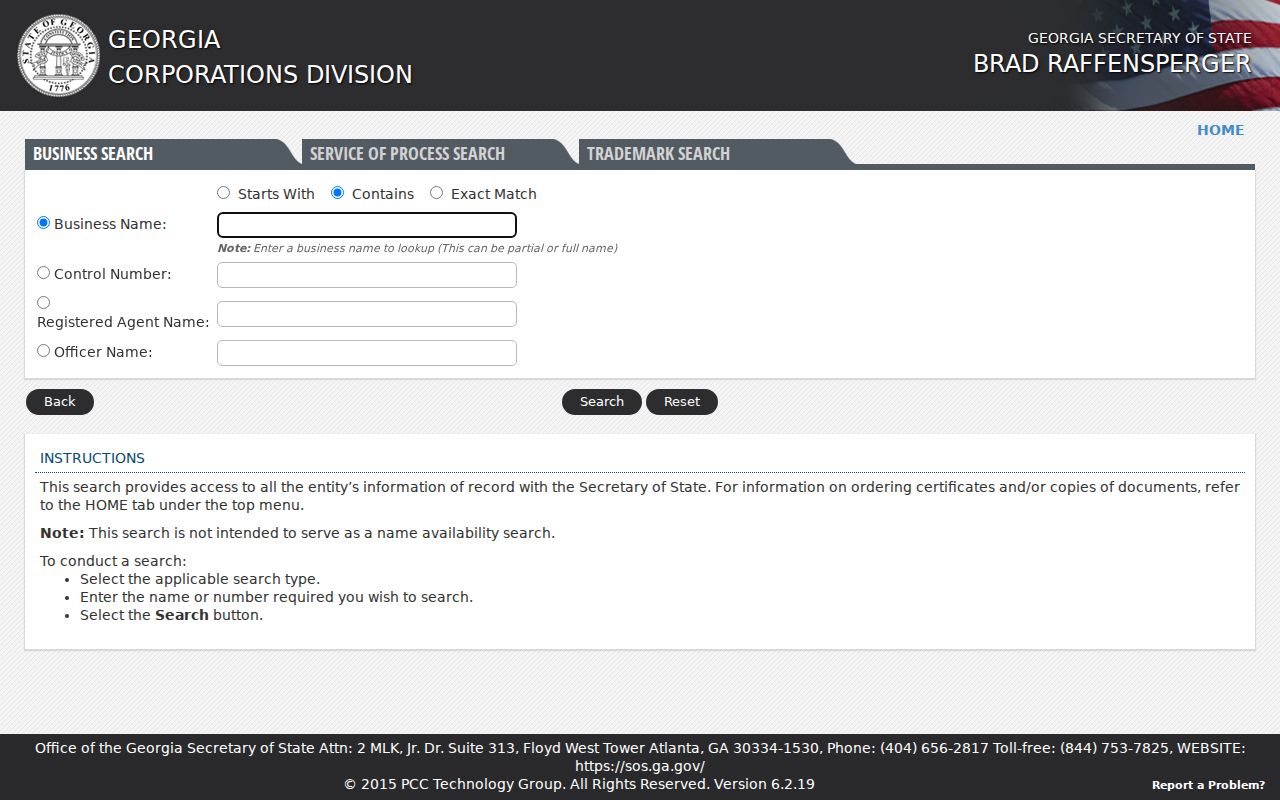
Pair an entity result with the Floyd trade-name filing or a current professional license when the identity needs more support.
| Field | Search use | Identity context |
|---|---|---|
| Registered Agent Name | Find entities served through a person | Agent role may not equal owner |
| Officer Name | Find a filed company officer | Check filing date and status |
| Designated Agent Name | Search the listed role | Confirm against entity details |
Checking Rome Voter Registration
Georgia's My Voter Page is an identity-gated self-service lookup. A Rome voter enters a first initial, last name, Floyd County, and date of birth. It can return registration status, polling places, election districts, sample ballots, and elected officials. The lookup is not the official registration record, and it should not be used to investigate an unrelated person.
The statewide voter file follows a separate paid order process and has strict limits. Georgia excludes the original application, Social Security and driver's-license data, full birth date, email, protected address information, and other confidential details. Participation history may show whether someone voted in an election, never the person's ballot choices. The complete record-set treatment belongs on the Rome voter records page.
Rome Directories With Named Roles
The City of Rome staff directory supports category, first-name, and last-name searching. Its department list reaches City Clerk, courts, police divisions, GIS, planning, public works, transit, water, and many other offices. Floyd County Schools uses a different model: readers browse a division or school and then inspect staff cards with a name, role, district phone, and extension.
Directories establish an official role on the date viewed. They do not prove a home address or a permanent connection. Search by department when a surname is unknown, and use role or division to separate same-name results. Professional licensing and corporation indexes add other named roles, while the library and dated phone collection support historical research. A full inventory appears in the Rome people directories.
Rome Custody and Registry Lookups
The Floyd County current-inmate roster filters by last name and displays current custody information, charges, and bond. It is not a conviction history. State custody belongs in the Georgia Department of Corrections locator, while court disposition belongs in the relevant court file. Verify time-sensitive status with the responsible office.
The Georgia Bureau of Investigation registry is a separate statutory resource whose data changes daily. Its gateway also points to registry law and downloadable information:
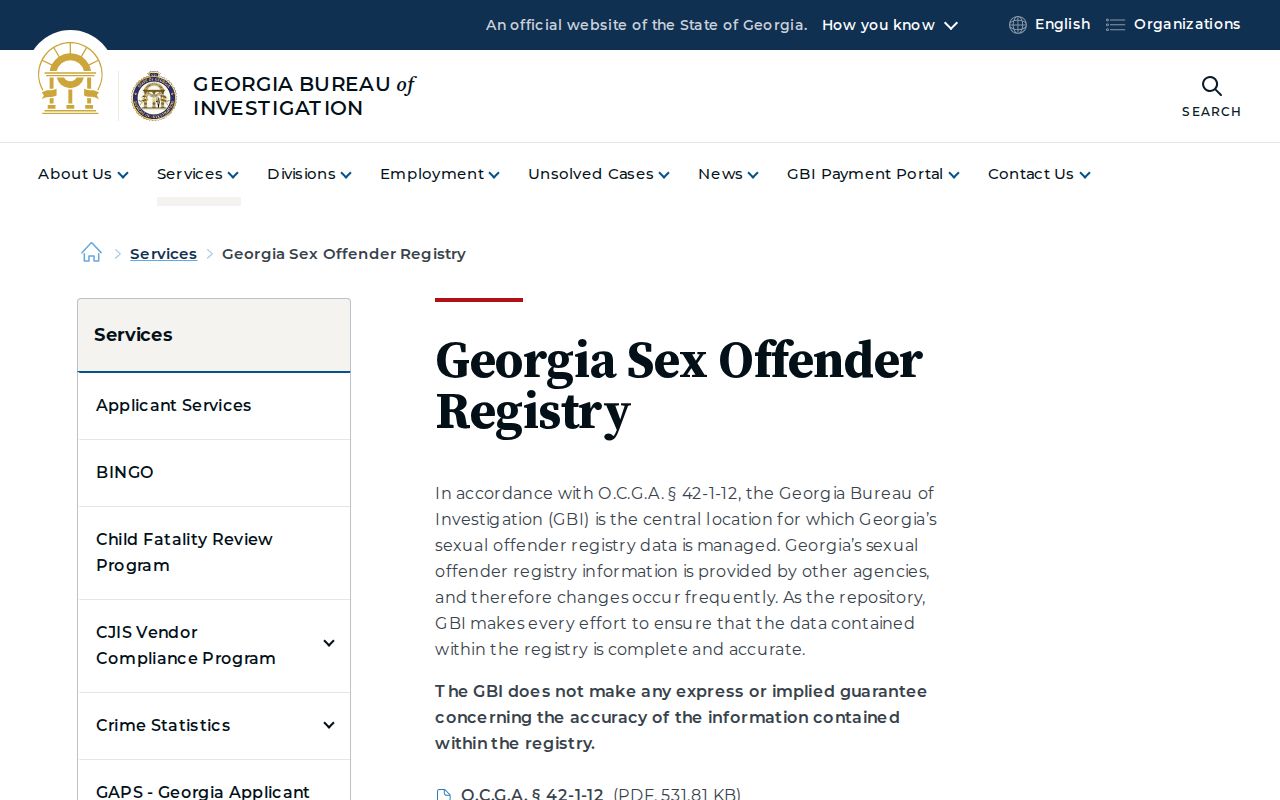
Names, dates, and current status must be checked at the source because custody, charges, and registry records answer distinct questions.
Rome Historical Search Timeline
Rome's sources form a rare sequence across four eras. Floyd Deed Book G supplies digitized images from 1850 to 1851. North Georgia Historic Newspapers includes Rome titles from 1850 through 1880 and more than 33,000 pages across the collection. Sanborn maps cover Rome from 1888 through 1926, while a verified telephone directory spans about 1936 to 1947. Current parcel and court tools then carry the trail forward.
Use each source for what it records. Deeds show ownership, Sanborn sheets show buildings and address form, phone books and newspapers can show occupants, and parcel records show the current tax identity. The Rome-Floyd County Library Heritage Room focuses on Civil War, Cherokee Nation, Southern history, and genealogy, but its exact city-directory runs were not verified. Call before planning a visit.
Neighborhood era helps set the order. Between the Rivers may require an 1850s deed and an 1888 or later fire-insurance map before a modern street search. College Heights research becomes stronger around Shorter University's 1911 move and later directories. East Rome and Oakdene can call for earlier maps, deeds, and news coverage. Rome's river and road history also means an old legal description may use a land district, lot, or physical landmark instead of today's street name.
- Grantor
- The person or entity transferring an interest by deed.
- Grantee
- The person or entity receiving the recorded interest.
- Situs address
- The physical parcel location, which may differ from the owner's mailing address.
- PIN
- The parcel identification number used to connect property systems.
Rome Courthouse Fire Limits
A March 2026 fire temporarily closed Floyd Superior, Juvenile, Magistrate, and Probate courts. The courts reopened March 26 with parking changes, and officials later considered stabilization and temporary relocation work. No official source reported record loss. The event can explain a service delay or changed counter location, but it cannot support a claim that a missing file burned.
The same caution applies to the 1864 burning of much of Rome. Floyd Deed Book G survives from the early 1850s, and no authoritative inventory proves that a particular courthouse record series was destroyed in 1864. Treat a gap as a prompt to check the Archives, courthouse index, and alternate record series.
Use records lawfully. Official access does not permit stalking, harassment, threats, or harm. Respect sealed files, protected addresses, and record-specific limits.
Safer Rome Search Verification
Records can also help test a suspicious claim. Georgia officials warn that criminals mine obituaries for survivor names, service details, and times when a home may be empty. A caller may spoof a funeral home's number and demand a wire, gift card, mobile payment, or cryptocurrency. Hang up, find the funeral home's published number independently, and call it directly.
Jury and law-enforcement impostors use a similar pattern, claiming a missed duty or warrant and pressing for personal data or instant payment. Courts and police do not settle such threats with gift cards. Business roles should be checked in the Secretary of State index, professional claims in the licensing portal, and deed offers against the Floyd Deed Room's official copy schedule. Strong verification uses the record custodian, a dated record, and an independently sourced contact method.
Commercial people-finder results may be stale, merged, or stripped of record context. Official indexes are narrower, but they identify the keeper, role, and date. Neither type should be treated as permission to contact, follow, or pressure someone.
Name variants deserve care as well. Rome's population includes many households where a language other than English is spoken at home, which supports testing removed diacritics, alternate spacing, double surnames, and anglicized forms. That is a search method, not a basis for assuming anyone's ethnicity. When names collide, use a dated role, address, associate, parcel, license number, or case number and keep uncertain matches separate.