
Rome Records and Their Keepers
Rome sits at the center of Floyd County, but no single office holds every open file. The Superior Court Clerk records land instruments and keeps court filings. The administrative County Clerk preserves Board acts, orders, minutes, permits, and licenses. Property data then split among the Board of Assessors, Tax Commissioner, and joint Rome-Floyd GIS. State offices hold other data, while each court controls its own case material.
| Record set | Custodian | Online route | Access |
|---|---|---|---|
| Deeds, liens, plats | Floyd Superior Court Deed Room | Cotthosting guest index | Free index; paid images; mail or counter copies |
| Court cases | Clerk of the court involved | County provider and public calendars | Account online; terminal and clerk fallback |
| Property appraisal | Floyd Board of Assessors | qPublic | Portal, office, or focused request |
| Tax digest and bills | Floyd Tax Commissioner | County tax portal | Portal or office |
| Estates and marriages | Floyd Probate Court | Georgia Probate Records, 2006 onward | Portal; older or full file at court |
| Vital records | DPH, local registrar, or Probate | Request systems, not a public name index | Eligibility, ID, fees, and redaction vary |
| Agency and police files | City, County, or police custodian | Request forms and office channels | Open Records Act, subject to exemptions |
Availability also depends on the record itself. Sealed cases, juvenile files, adoption material, confidential voter fields, protected addresses, Social Security numbers, financial data, and medical details can be closed or redacted. A public index is not a promise that every underlying image is free or open.
Georgia Rules for Rome Records
The Georgia Open Records Act, O.C.G.A. §50-18-70 et seq., allows any person to request an existing agency record. The agency must produce it within three business days or send a written response that gives the expected production time, estimated cost, and exact statutory ground for any withheld part. The deadline is a response rule, not a guarantee that a large off-site set will arrive in three days.
Under §50-18-71, the first 15 minutes of search, retrieval, and redaction time are free. Later labor is capped at the rate of the lowest-paid full-time employee qualified to do the work. General copies are usually capped at $0.25 per page unless a more specific law sets the fee. Electronic delivery should be used when practical and economical. An office need not write a new report or compile an answer that does not already exist.
- Custodian
- The office legally responsible for the requested record.
- Index
- A list that identifies a record; it may not include the document image.
- Certified copy
- An official copy authenticated by the record keeper.
- Exemption
- A statute that permits or requires specific material to be withheld.
Note: An office must redact an exempt portion when the rest can lawfully be released, rather than withhold the whole file by default.
Rome City Records Request Channels
The City Clerk at 601 Broad Street routes commission minutes, ordinances, permits, administrative correspondence, and other existing city files. Rome states that a request need not be written. Its form still helps establish scope and receipt time because it asks for the requester's printed name, date, and a specific description of the records sought. If files are not ready within three business days, the City supplies a timetable and cost response.
Police material follows a separate route. The Rome Police records instructions direct the completed police form to openrecords@romepolice.com. Requests may be taken by email, mail, fax, phone, or in person. The form asks for contact details and a clear record description; staff fields document receipt mode, disclosure decision, notice, and production. Incident or accident reports belong there, not with the County Clerk.
Ask for the existing report, permit, meeting record, or correspondence by date, address, unit, and report number when known. A narrow request cuts search time and reduces the chance that unrelated private details must be reviewed.
Rome Deed Records Beyond Login
The Floyd County Deed Room records deeds, liens, plats, trade names, and other instruments. Its Cotthosting portal offers free guest access to index data, while document images require a timed subscription. The verified login gateway exposes User ID and Password fields, account creation, a password reminder, certified dates, and PropertyCheck. Inner grantor, grantee, date, and document fields were not visible without an account, so their exact labels and the online start year should not be assumed.
| Portal field or control | Type | Required | Use |
|---|---|---|---|
| User ID | Text | Yes at login | Guest or subscriber account identity |
| Password | Password | Yes at login | Account access |
| Create Account | Link | No | Opens guest or paid access setup |
| Certified Dates | Link | No | Check portal coverage before relying on a no-match |
| PropertyCheck | Link | No | Service terms were not verified in the research |
Image subscriptions cost $5 for one day, $30 for one month, $80 for three months, or $150 for six months. Prepare a list of book and page references before starting paid time. Plain copies from the office cost $1 per page. A court-certified copy costs $2.50 for the first page and $0.50 for each added page. Mail requests go to the Clerk of Superior Court, Attn: Deed Room, Suite 103, 3 Government Plaza, Rome, GA 30161, with document type and book/page.
The separate GSCCCA statewide index contains only a limited set of Floyd instruments. A missing online hit is not proof that no deed exists. Older indexes and omitted entries require the courthouse records.
Rome Property Records Use Four Systems
The Floyd Board of Assessors maintains ownership, tract size, sale price, zoning, land features, deed restrictions, building measurements, construction facts, and scaled drawings. Building permits and field reviews can update those files. Its qPublic portal is the current appraisal route, though the live search fields were blocked during research. The Tax Commissioner handles the digest, bills, and collection. Those are different duties.
The Rome-Floyd GIS program links parcels to mapped geometry and a PIN. Its replacement viewer lacks some former layers, including layers planned for later grouped water, voting, and special-district applications. A map is useful for discovery, but it is not a survey or a certified title record. The deed remains the title source, the appraisal roll tracks current assessment data, and the tax file tracks the taxpayer and bill status.
Owner versus occupant. A homestead flag is meaningful because the applicant claims ownership and legal residence as of January 1, but it does not prove who lives there today.
Mailing and situs addresses also serve different purposes. Situs means the property's physical location. A tax mailing address may point to a post-office box, agent, or another residence. Date each observation and compare it with the recording date of the latest deed.
Rome Records Cross City Lines
A Rome postal address may sit outside City of Rome jurisdiction. Joint city-county services, annexations, and several taxing authorities make the mailing label an unreliable test of which agency holds a permit or tax record. Start with parcel geometry, city-limit status, and taxing authority. Then direct the request to the office that created the file.
This matters most near boundary areas and when a jointly branded Rome-Floyd department appears on a source. The joint GIS may locate the land, the county Assessor may value it, and a city or county inspection unit may hold the permit. Record creation and legal custody are not always in the same department.
Note: Use the parcel PIN and legal description when a street address is normalized, changed, or shared across systems.
Rome Court Records Need Court Routes
Judicial files may be public, but they do not use the normal agency-request path. The Judicial Council e-access directory routes Floyd searches to an account-based provider. It does not promise one statewide database, common coverage, or a full docket for every county. Current judge calendars can identify a party, judge, hearing type, and date, but they are not a full case history.
The strongest verified fallback is the public-access terminal and printer in the third-floor courthouse law library. For a written or counter request, name the court, exact party spelling and aliases, approximate year, case class, and case number if known. Ask separately for the docket sheet, filed documents, orders, or a certified final disposition. A docket is the ordered list of events and filings in a case.
Floyd Probate has an online route for records from 2006 onward, including estates, guardianships, marriage, petitions, and some will material. Earlier or complete files require the court. Magistrate copies are $1, certified copies $2.50, and exemplified copies $5. Juvenile, adoption, sealed, and protected guardianship material is restricted. The administrative County Clerk cannot substitute for a court clerk.
Rome Vital Records Access Levels
Georgia does not provide a public browse-by-name index for current birth and death certificates. The Department of Public Health holds statewide birth and death records from January 1919. Birth certificates require direct and tangible interest under O.C.G.A. §31-10-26. Certified death copies also require support, but a member of the public may request a plain-paper death record with the Social Security number redacted.
The official DPH death-record page shows the request channels and links Form 3912.
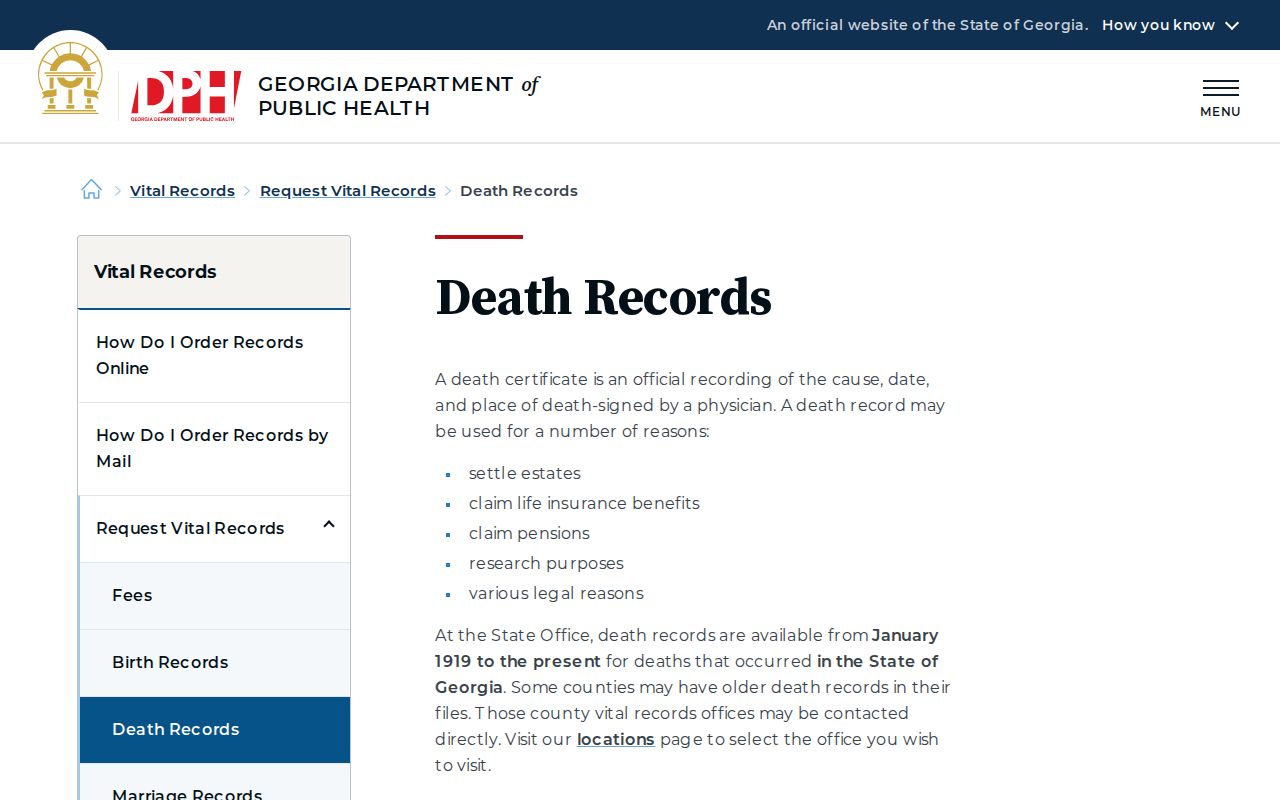
The form asks for the decedent's legal name, last name at birth, death facts, place, aliases and parents, plus requester identity, relationship, contact information, signature, and copies sought. Mail requests need a signed form, photo ID, and certified check or U.S. money order. The death page gives an 8-to-10-week mail estimate.
Birth and death searches cost $25 for the first certificate and $5 for each extra copy ordered at the same time. Marriage requests through the state cost $10 plus $5 for extras, but DPH publishes conflicting end dates in 1996 for its holdings. Floyd Probate is the route outside the state range. Under §31-10-25, births transfer to Archives after 100 years; deaths, marriage applications, and divorce-related records transfer after 75 years. That schedule is not a claim that every death fact stays closed for 75 years.
Rome Public Records Office Contacts
Send each request to the office that keeps the source. Three local contacts cover much of the records system, while courts and police retain their own channels.
Floyd Superior Court Deed Room
3 Government Plaza, Suite 103
Rome, GA 30161
706-291-5206
Deed index and copy access
Floyd County Clerk
12 East 4th Avenue, Suite 209
Rome, GA 30161
706-291-5110
Board and county agency records
Floyd Board of Assessors
5 Government Plaza
Rome, GA 30161
706-291-5143
Property appraisal records
The County Clerk handles Board minutes, acts, orders, county licenses, administrative files, and retention coordination. It is not the deed recorder. Probate Court at 3 Government Plaza uses named desks, including the estate clerk at 706-291-5139, which is a better route for an estate file than a broad county request.
Rome Custody and Registry Records
The Floyd County current-inmate roster filters by last name. Result cards may show a photo, name, age, arrest date, charges, warrant details, code section, counts, and bond. It covers current custody only. An arrest entry is not a conviction or final case result, and the roster does not state historical coverage.
For state custody, the Georgia Department of Corrections locator searches by description, name, ID, or case number. GDC can verify a result by phone or mail. The GBI registry searches by name and county, changes daily, and carries official accuracy limits. No match can reflect a name or county mismatch, reporting lag, death removal, lack of a registration duty, or other lawful status. Court records remain the right source for disposition.
Rome Records Survive Changing Courthouses
Rome became the Floyd County seat in 1835, and the current courthouse is the county's sixth. A building date does not mark the beginning of the record series. Union occupation and the 1864 burning changed much of the built landscape, but no authoritative inventory proves that a specific courthouse series was destroyed. The safe approach is to check surviving local indexes and the Georgia Archives rather than treat the fire as a blanket records gap.
The Georgia Archives Virtual Vault copy of Floyd Deed Book G proves that an 1850–1851 volume survives.
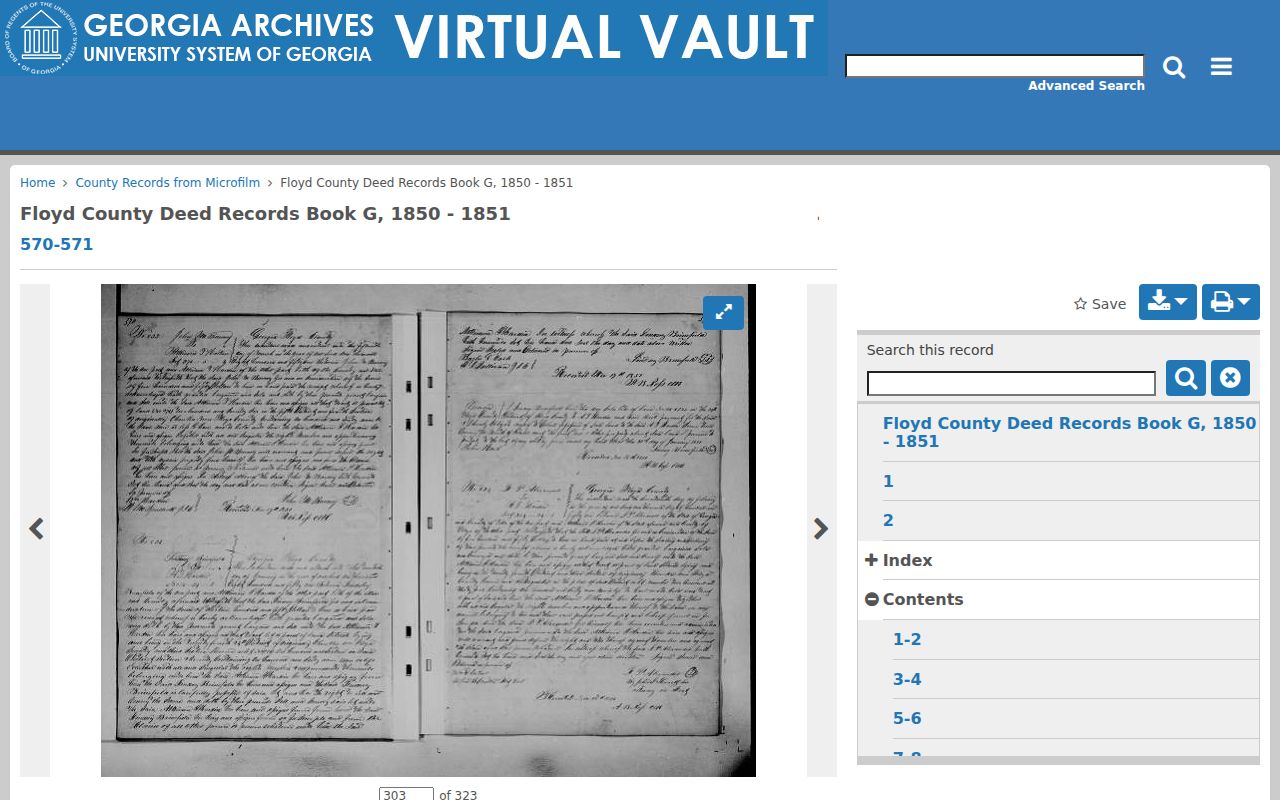
The viewer supplies digitized pages and metadata, but the volume has irregular pagination and a recorded gap. That detail calls for careful image-by-image review, not a broad conclusion that missing page numbers mean all related instruments vanished.
A March 2026 courthouse fire temporarily closed Superior, Juvenile, Magistrate, and Probate operations. The courts reopened March 26, with later stabilization and relocation planning. No official record-loss report was found. Call the relevant clerk before an in-person visit while operations settle.
Rome Records Systems Keep Changing
Three recent changes affect access without changing the basic custody rules. Since January 1, 2025, Georgia self-filers of real-estate documents must e-file and verify identity through the Clerks' Authority. That rule changes intake, not the public's right to inspect or buy copies. In July 2025, Floyd assessors discussed purchasing access so citizens could use qPublic free. Live portal terms should still be checked before relying on that discussion.
Rome-Floyd GIS also replaced its parcel viewer. The official GIS office warns that some former layers are not yet present and are planned for grouped applications. An absent layer can be a platform limit, not proof that no district or utility record exists. Ask the responsible office for authoritative boundary information.
Request Rome Public Records Precisely
A useful records request asks for existing files and gives the custodian enough detail to find them. It also states the desired format and a cost ceiling. Forms are optional for most agency requests, but a dated written submission makes the scope and response easy to preserve.
- Identify the office that created or keeps the record. Use the court clerk for cases, Deed Room for instruments, and City or County custodian for agency files.
- Check the official index first. Save the exact party spelling, date, case or parcel number, document type, and book/page when shown.
- Describe a tight date range and the existing documents wanted. Ask for native electronic delivery when practical.
- Request notice before costs exceed a set amount. If the estimate is high, narrow the dates, subject, or file type.
- Review any denial for the exact code section and ask for segregable, nonexempt portions. Preserve every timestamp and response.
If a City or County agency dispute remains, the Attorney General's Open Government Mediation Program offers an informal complaint channel. The complaint itself is public and may be shared, so omit personal detail that is not needed. Court access disputes follow judicial procedures instead. Superior Court enforcement under O.C.G.A. §50-18-73 is the statutory court route for agency-record disputes.
Lawful personal use. Use Rome open records for legitimate research, civic review, family history, estate work, and fraud checks. Never use a name, address, or record to stalk, threaten, harass, or harm someone.