
Search Rome Voter Registration
Georgia My Voter Page, often called MVP, is the first stop for a Rome voter who wants to confirm a registration. The tool is free, but it is not an open directory. It asks for facts already known to the voter and checks an extracted view of the statewide database. Floyd County Elections keeps the official registration record. MVP can return registration status, an update path, advance and Election Day polling locations, districts, a sample ballot, and elected officials.
The form uses all four identity fields shown below. Select Floyd County only when that is the voter's county of registration. A Rome postal address may not prove the correct election jurisdiction, so do not guess from the city name alone.
| Lookup field | Input type | Required | How to enter it |
|---|---|---|---|
| First Initial | Text | Yes | Use the first letter of the registered first name. |
| Last Name | Text | Yes | Use the current legal surname on the registration. |
| County | Georgia county list | Yes | Choose Floyd for a Floyd County registration. |
| Date of Birth | Date | Yes | Use the voter's actual birth date. |
The birth-date gate prevents surname browsing. When the search does not match, check the initial, legal surname, county, and birth date in that order. Then contact Floyd County Elections about the official record. A recent name, address, or registration update may not appear at once in the extracted web view.
The official MVP form shown here displays the identity-gated path used by Rome voters.
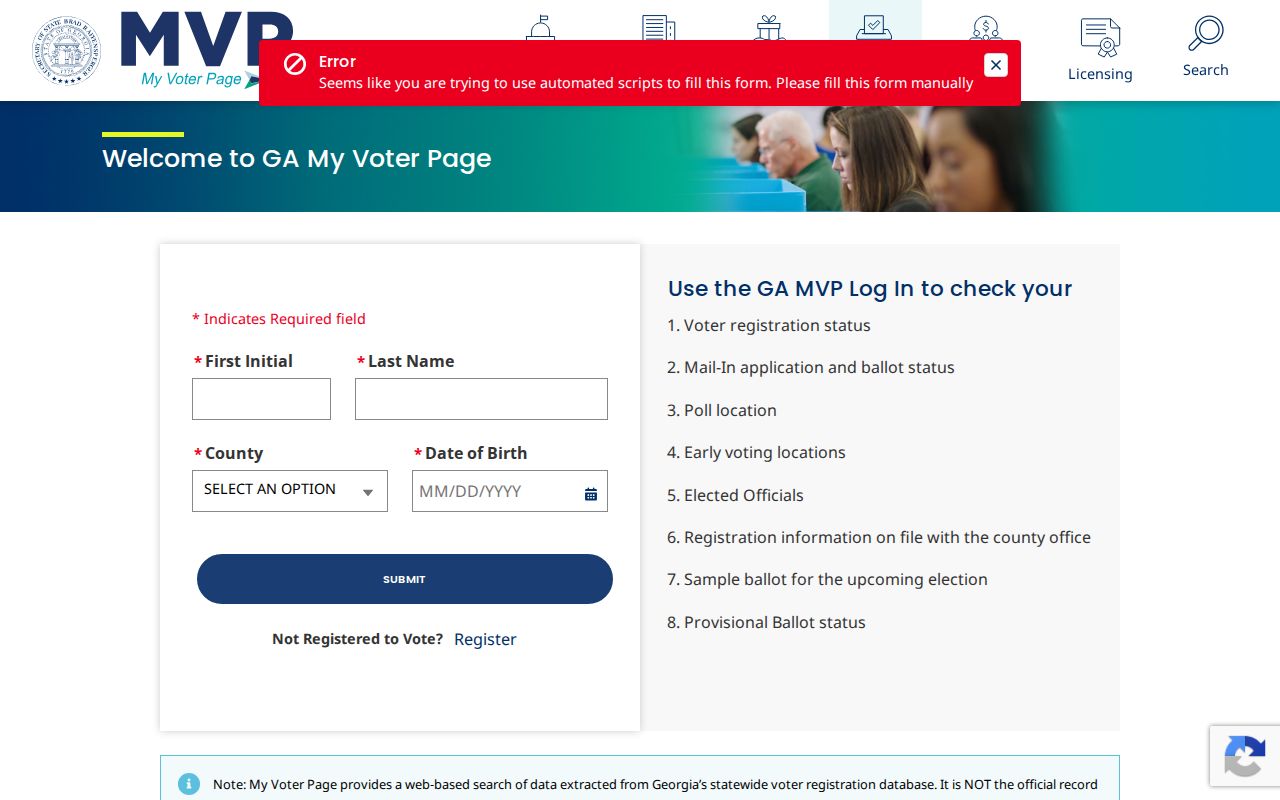
Its four-part gate explains why the portal confirms one known voter rather than listing everyone who shares a surname.
Rome MVP Results Explained
MVP is useful for a live check, but its result is not a certified copy and not the official voter registration application. Record the lookup date along with the status because the web view can change after updates or list maintenance. Polling sites and district assignments are also time-sensitive. The sample ballot tells a voter which contests may appear for that election; it does not reveal how anyone voted.
When a result conflicts with a notice or other official paper, the county-held record is the better source. Floyd County Elections can inspect the official registration and address an update that has not yet reached the extract. General access-law questions belong with Rome public records access, while voter applications follow the narrower election-law rules discussed here.
Note: Save the status and search date, since a later extract can reflect a registration update, district change, or maintenance action.
Fields in Georgia Voter Records
The ordered Georgia voter file has a much broader schema than MVP. Public fields identify the voter, the registration state, a structured residence address, election geography, and the dates that help show freshness. Status Reason, Last Modified, Last Contact, and Date Last Voted all need careful labels. They do not prove a current home address by themselves.
| Identity | Name, middle name, suffix, voter registration number, birth year, race, and gender. |
|---|---|
| Residence | House number, directional parts, street, unit, city, ZIP, land lot, and land district. |
| Registration | Status and reason, registration date, last modified, and last contact. |
| Election geography | County and municipal precincts plus congressional, legislative, judicial, commission, school, council, water, fire, and other districts. |
| Participation | Date last voted or election participation, never a ballot selection. |
| Contact | The distributed file excludes phone and email. |
District columns reflect the geography encoded when the file was made. Annexation and redistricting can change those assignments. Rome researchers should treat a district as dated metadata, not a timeless fact.
Rome Voter Record Privacy
Georgia draws a firm line between maintained elector data and the original application. Under O.C.G.A. §21-2-225, the original voter registration application or its copy is closed unless a court orders access. The public file omits bank statements, month and day of birth, Social Security number, email, driver's-license number, and the location where the person applied. Some identifying data may be shared for authorized government matching, but that does not make it public.
Confidential by Georgia law. Month and day of birth, Social Security and driver's-license numbers, email, original applications, and protected actual addresses are not public voter-file fields under O.C.G.A. §21-2-225 and the Address Confidentiality Program.
Eligible Address Confidentiality Program participants use a substitute address held through the Secretary of State. Their actual address and application remain confidential under O.C.G.A. §§50-18-150 et seq. A substitute address is a safety control, not a data flaw to work around.
Rome Voting History Limits
Georgia does not register voters by political party. A primary ballot choice does not become permanent party registration. The voter file may show election participation or Date Last Voted, but the secret ballot protects the person's choices. Never describe participation data as proof of a vote for a candidate, party, or measure.
The same caution applies to registration status. “Inactive” is still a status, not a finding that the person moved or lost eligibility. Use the status, reason, last-modified date, and lookup date together. Unsupported conclusions can turn a precise government field into a false claim.
Order Floyd County Voter Records
The Georgia Secretary of State voter-list service supplies paid bulk files. It is separate from MVP. The order form asks for the buyer's name, billing address, contact person, phone, date, description, signature, and a deliverable email. Scope choices include statewide, active only or active and inactive, county, municipality, district, precinct, or neither district nor precinct.
- Choose the smallest geography that fits the work. Write Floyd as the county and specify City of Rome only for municipal scope.
- Select active-only or active-and-inactive records with care. Add a precinct or district only when it is known.
- Sign the form, provide contact and delivery details, and submit accepted payment. The state accepts check or money order, with card payment available online or in person.
- Allow one to two weeks for email delivery. The state offers no expedited service and no custom extracts or refunds.
Most orders arrive as CSV files, which open in spreadsheet software. A statewide order comes as text and needs to be imported. The distributed file excludes phone, email, date of birth, Social Security digits, and driver's-license number, but it includes birth year and Date Last Voted.
Georgia Voter File Prices
Geography sets the price, so define the needed Rome boundary before paying. A municipal file may fit a city-only project, while the Floyd County file covers a wider area. Precinct orders can cost less when no more than five are needed. Prices below took effect July 1, 2024.
| File scope | Price | Rome research use |
|---|---|---|
| County or municipal precinct, up to five | $35 | A defined set of local precincts. |
| County district / municipal district | $45 | One known district. |
| Municipality | $65 | City of Rome scope. |
| County | $70 | All of Floyd County. |
| State House / State Senate | $75 / $95 | A legislative district. |
| Congressional / judicial circuit | $125 | A broader election boundary. |
| Statewide | $485 | All Georgia counties. |
Returned checks draw a $40 charge, and starter checks are not accepted. Because the state does not issue refunds or make custom orders, confirm whether Rome municipal, Floyd County, precinct, or district coverage is the real target before submission.
Note: The official order page and form should be checked for current prices and instructions before payment.
Rome Voter Roll Maintenance
On July 29, 2025, the Georgia Secretary of State announced mail to 218,951 active registrations with no activity in five calendar years. A voter who did not respond would move to inactive status. Remaining inactive through the 2026 and 2028 general elections could place that registration into the 2029 cancellation process.
This multicycle sequence matters. Inactive does not mean an instant cancellation, and it does not prove that a Rome voter left an address. A recipient can respond by updating the registration, using MVP, or returning the postcard. For research, capture the status and date instead of converting a maintenance label into a claim about residence.
Lawful Use of Rome Voter Records
O.C.G.A. §§21-2-225 and 21-2-601 prohibit commercial use of elector lists, and a violation is a misdemeanor. Voter records also must not be used to stalk, threaten, harass, or defeat an address-protection measure. The official restrictions travel with the data even after a file has been delivered.
Use the file within its legal bounds. Keep the order terms, preserve the extraction date, do not republish confidential data, and report suspected misuse to the Secretary of State Elections Division or Floyd County Elections.
A lawful family-history or civic project still needs restraint. Participation is not a ballot choice, status is not proof of residence, and a substitute address must remain protected. These limits preserve the difference between factual record use and harm.
Historical Floyd Voter Records
No official catalog entry establishing exact years for Floyd County poll books or old registration registers was located in the research. That gap should remain explicit. Do not claim that a historic series survives, starts in a certain year, or was destroyed without an authoritative inventory.
The sound fallback is to ask Floyd County Elections, the Georgia Archives research staff, and the Rome-Floyd County Library Heritage Room. Give the person's name, approximate election year, precinct or address if known, and the exact record type sought. Staff can then check local custody, archive holdings, or related sources without assuming that a modern online voter registration tool covers the past.